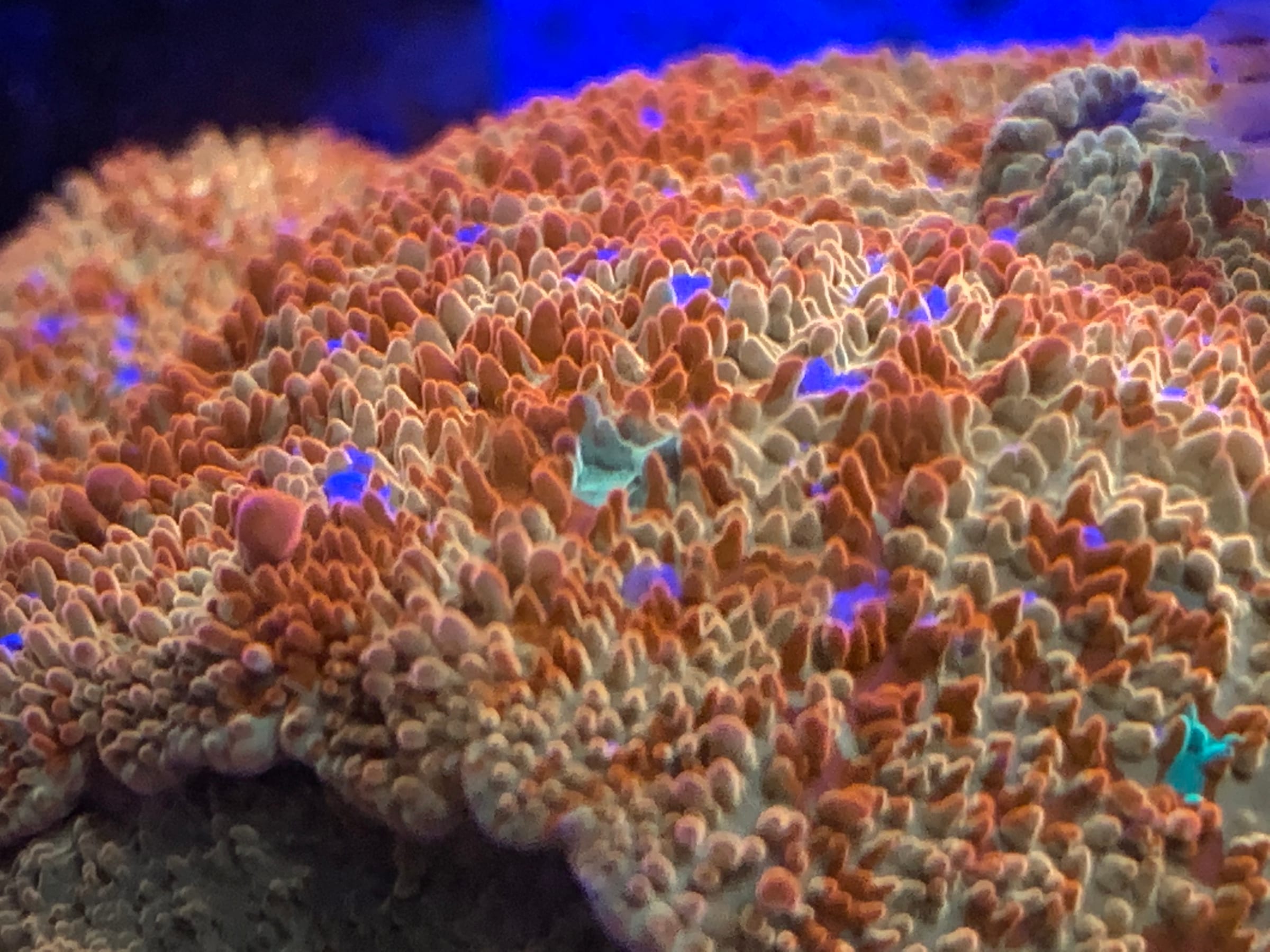
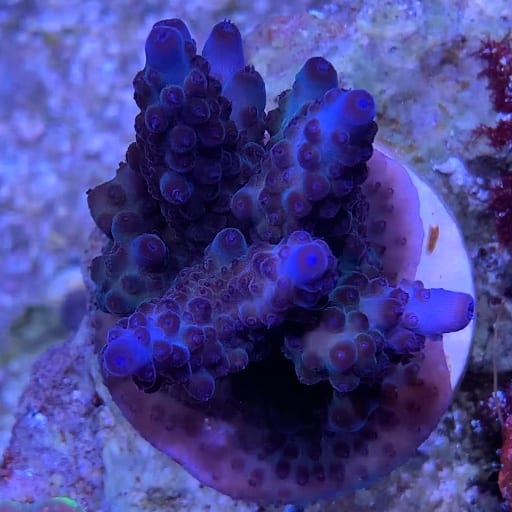

Acropora and clams are my vice.
Yeah, I'm in the 8020 camp from now on. Especially after making my own.
> @BackbayReef wrote: > @Drexl I’m currently at 15 / 0.13 * 1.53 = 177 based on N/P x 1.53. That’s way above the 50 molar ratio as referenced. My PO4 is super stable since I’m dosing LC at 20mL/day. > > I can drive NO3 down further but my stupid sulfur reactor has been channeling lately (media clump) hence pushing that down further has been challenging. I might swap out the Aquamaxx TS-3 (bad design tbh) for a GEO this weekend, if time permits. I use polyp lab genesis blocks for nitrate reduction. It takes done time before they are fully cultivated with bacteria and start to consume nitrogen, but once they do, then it’s easier to add a little back. Types of food will help control nitrate and phosphate too.
> @Ndrwater wrote: > The one on the left is Spatholata i believe. > As @Drexl said, high ligt and high flow And fun fact, spathalata, prostrata and millepora are all millepora now after genetic/dna sequencing. It’s kinda crazy, mostly because all spaths are “fat”, prostrata is typically “skinny” and millies are in between. But they’re all found next to each other, so I guess it makes sense? 🙄
Yeah, there were a few that looked like humilis or digitifera. They’re usually found in high flow, wave heavy parts of the reef, which explains their stubby, stocky growth patterns. They usually thin out in tanks that don’t get enough flow. One of my favorite growth forms. Very cool.
Was this from Rita’s? There were a couple next to the millies that kinda resembled humilis or the digitate varieties like humilis, gemifera, etc High light and high flow. The axial corallites are pretty unique to that group, so time will tell. Looks cool though.
> @mescobar wrote: > I'm considering automating my LC dosing with a heavily diluted LC solution (for overdosing peace of mind). I agree that a diluted solution also helps in spreading the LC over the course of the day. > > I was doing some research and it seems like dosing LC into the venturi is more effective than into the skimmer neck, which is how I normally manually dose it. Does anyone have experience dosing LC directly into their venturi? Some people t-off the venturi tube directly. Any consideration against doing this? Could it make the skimmer less effective? The problem with doing it this method is the LC can bind to the impeller, motor, etc and creates a buildup, which can destroy those parts. If you look at the skimmer neck when dosing, you’ll see that buildup, which is easily removed with a little vinegar or citric acid.
> @BackbayReef wrote: > @Drexl - we should start a poll to see what people do since WC alone won’t reduce PO4, constantly leaching out from rocks & sand. > > I used PhosBan before but found GFOs in reactors was very messy and uncontrollable! Currently, I can change PO4 from my phone. Yeah, I’m not a fan of GFO’s either. I think if you have a slight increase, it’s easy enough to deploy, but long term gets messy and finds its way into the display.
For anyone who wants to create a diluted stock solution of any given supplement, I use the 30 day formula, which works like this: To create a 1L stock solution, calculate what your daily amount would be, for this example we’ll choose 12mL/day. 12 x 30 = 360 Subtract 360 from 1000, which is 640. So you’ll mix 360mL of your element into 640mL of RO, this is your 1L of diluted stock solution. Now to dose over the course of 30 days, we’ll divide 1000 / 30 = 33.333, so you’ll dose 33mL a day of that solution. For LC, I like to dose smaller amounts over the course of 24hrs, so I double the hours and dose 48 times a day. You can always reduce the amount at first so you’re only dosing half the amount, then slowly increase over a week or so depending on your current levels. For PO4 adjustments, I go extremely slow, as to not change it quickly. Hopefully this helps anyone who wants to create stock solutions.
Once my fish return to my 90g I’ll most likely go back to dosing LC directly into to the skimmer body like before. I always dilute it and dose small amounts, as I want to prevent any flocculant from entering the display. I use TM Elimi phos rapid. I use this calculator to figure out my stock solution. larryl.emailplus.org.user.fm/fish/dosing-instructions-phosphate-removers.html
Yeah, I might have to switch to the TM reagents and give it a try. If you haven’t watched any of SciReefs vids, do yourself a favor and subscribe to their channel. They are spawning Trachys, acropora and other corals. And those corals look amazing and healthy. If I’m not mistaken they now have the ability to ship outside of Germany?
That's a pretty good deal for all of that material/hardware.
Elevated co2 in the room and dissolved organics will decrease pH. If running a refugium with macro algae, when the macro is not photosynthesizing it's expiring co2, which during the day, can drop pH levels. The more macro you have, the more co2 will be released in the tank. Quick tip about pH probes before replacing one, simply check that it no longer holds calibration by checking with calibration fluid. If the probe is close to the calibration level, simply re-calibrating it should do the job. But if doesn't calibrate properly, then it's time to replace. Most pH probes are good for a year or two, after that I don't find them that reliable.
I buy pretty much all my hardware from Tnutz. I did order black anodized extrusion from them once and it looked like they dropped it several times and never cleaned the saw, there were so many marks that I returned the extrusion. But that may have been a one time thing? I think if you’re ordering clear anodized extrusion, then you’re fine. I did have 8020.net cut and mill my light racks in black, which turned out nicely. But Tnutz is usually my first stop when looking for 8020 related stuff.
> @ktran wrote: > Gotcha makes sense. It is an extruded aluminum stand and the tank did leak lol. I believe the bigger issue is red sea's silicone is terrible as their g2 tanks still leaked with their stand "fix" Then you may be safe with an extra thick top, as long as the complete bottom of the tank is supported by that material. Then the question may be how does it look with an overhang? Is that something you’re good with?
> @ktran wrote: > Def will add leveling feet. > > I found a red sea stand where the tank leaked. But it's only 24wide and the tank is 26 wide.... wondering if I put plywood or marble/granite on top that 1" will be ok each side.... 🤔 I’m not sure, it might work? Personally I would feel comfortable if the edges/sides were partially supported directly below, but I’m not sure about the physics? If the stand was steel or aluminum, probably safe, but for wood stands, I want complete support. I think the reason why all of the Red Sea tanks fail, it’s because the front panel is completely unsupported. I think if the material you use has enough mass/strength, then it could work.
I drilled and tapped the legs so I could add leveling feet, which I find necessary for a nice level stand. You can wrap the stand with expanded PVC panels and they make them in all different colors. There’s plenty of hardware for attaching the panels.
If you have a miter saw, then you can cut it yourself, just need a proper blade. Just cover yourself the the area where you cut, aluminum shavings go everywhere. I made the one for my son’s 50g lagoon and I had a friend with a cnc machine do the counter bores for me, but those aren’t necessary, they just make hiding certain joints hardware more convenient. I used 8020.net for my light racks and I had them mill certain pieces to make the joints cleaner, which costs more.
Yeah, it’s pretty amazing.
Yeah, clams uptake nutrients directly from the surrounding water, so if they’re big enough or you have several, they can definitely impact your nutrient levels. If you don’t have enough fish and feed them frequently, then supplementing nitrogen and phosphorus is required.
I have no confidence in salinity probes, too many issues to make them reliable for true readings. I use two trusted instruments for testing salinity, glass hydrometer (Tropic Marin) and D/D Ocean refractometer. One of the best refracometers is the VeeGee STX-3. You can also make your own calibration solution for a refractometer with table salt and RO, but requires a scale with 1/100 accuracy. I keep salinity at 35ppt to keep it simple and that's what every test kit is based off of, so if you're salinity is off, then your test results are off.
I dose polyp lab reef roids twice a week to help maintain levels while my tank is running fallow and I’m doing about 24mL of ammonium bicarbonate a day to keep nitrate around 2-4ppm. I’ve also cut back on live phyto, only feeding half my normal amount. I tested on Saturday and N was 0.3ppm and P was 0.13ppm. Clams suck up a lot of it. 😂
> @janiners305 wrote: > So with my last numbers of 2.5 nitrate and 0.04 PO4, I’m at 95.625. Yikes.🫣 > > I’m gonna retest today to make sure of where we’re at. 0.04 is the testing error of most phosphate kits, so I always treat PO4 that low as zero. Also, it's nothing to worry about or something that you want to change rapidly, just slowly increase your PO4 levels and see what happens. Once you get to the 0.08ppm range, most corals do better overall. If you need or want to raise PO4, Randy Holmes Farley recommends using trisodium phosphate (food grade) as a DIY solution. 1.88grams into 1L of RO, 1mL of that solution will raise PO4 by 0.01 in 26g/100L
Part 2
Rip clean before and after.
> @janiners305 wrote: > Thanks for the melting point. We will keep that in mind. > > As for the PO4, that’s not an issue either. Ours is usually undetectable on test kits, so we are dosing to keep it just barely detectable. Last test was 0.04, and nitrates were 2.5. I’m a heavy feeder too, but I think all of the corals are consuming most of the PO4. Here’s my recipe/ratio for nutrient balance. It’s a molar ratio, so the key/goal is to be as close to 50 as possible. It’s not about the actual numbers, but there’s relationship with each other. Nitrate divided by phosphate, then multiply by 1.53 For example: N 3ppm, P 0.09ppm 3 / 0.09 x 1.53 =51 You’ll notice several things, algae growth on the glass will take longer, less weird algae overall, and most of all, good healthy growth of corals. PO4 is very important, so keep it in the “healthy “ range and you’ll be okay. My healthy range is > 0.05 - 0.2, with the sweet spot being closer to 0.1 give or take a little.
> @janiners305 wrote: > We are using the re-born media from two little fishies. It’s the same stuff we used before in the old tank. Cool, it has a melting point around 7.5, so you don’t need a lot of co2 to get the job done. Two things to remember/consider with reborn. It adds PO4 to the system because phosphate is bound to the skeleton and it gets messy over time. I’m a heavy feeder, so I don’t need the extra PO4, which is why I use the Tunze calcium carbonate media, it’s super clean and it’s just pure calcium and alkalinity. Btw, I have the same reactor.
> @janiners305 wrote: > We've got the pH probe inside the CaRx also. We are running our old Geo 618 I think it is. On our old 135g, this reactor was the best thing we did. It helped the most with growth and color. Hubby is looking at the Kamoer FX-STP2 I think right now...we are just running the needle valve at the moment. I set up my CaRx to my tanks demands and I try to keep it as simple as possible. I use a masterflex as my feed pump (which pulls water through) at a constant rate, usually 50-60mL/minute. I then set a bubble count to reduce pH in the chamber just below the melting point of the media I'm using. I test alk about every 12hrs in the tank, if it's not where I want it to be, I simply add more co2, very small turn of the solenoid. Wait another 12hrs and test. Once I get to my desired dkh, I test occasionally to make sure all is well. This is how I've always used a CaRx running 24/7. I've modified this method now in order to keep pH from falling too much at night, so I only run the CaRx during daylight/photo period and kalk at night. If I need more alk, then I either add more kalk or simply add another hour of time "on" with the CaRx or simply adjust the co2. What media are you going to use?
I played whack-a-mole with valonia using my trusty spear siphon. I got through about 2/3 of it, but my arm got tired stabbing the s*** out of it. Tomorrow I do a major w/c and cleaning of my nano system, then back to finish up the rest of the valonia stabbing. Pitho crabs are busy every night, but I think I could use more, so I might need to make another trip soon?
I think Telegraham took the machine apart and listed what would be needed to build your own, but it’s not as cheap as you think it is, if memory serves me? My friend has one and really likes it. I like the idea, but it’s still too expensive for what it Is. I just want a machine that tests once a day at the same time and that’s it. The whole testing multiple times a day is a waste and completely unnecessary for our purposes.
Welcome!
> @BackbayReef wrote: > Simply amazing - that’s so mesmerizing! My Teardrop is super boring compared to these. Nicely done, love it!!! I don’t know, I think all clams are awesome. Zoom in on your noae and you’ll start to see the details, which are pretty unique. One cool thing about noae that have teardrops is, the teardrops almost always have a surrounding highlighted color. There are a few teardrops within the mantle that are solid with no highlights, but it’s that highlight that makes them even cooler than others. There are some crocea that have teardrop patterns, but they’re oblong or funky, but they’re just one color. Noae from Western Australia are even cooler, as most don’t actually have teardrops, but may have a few in the center part of the mantle and the ones without teardrops are usually peppered with papillae.
Crocea and maxima.
And a couple more.
A few more.
Yeah, I like the ornamental macros better, they’re not fast growing, add some nice color and give refuge to the micro critters.
> @BackbayReef wrote: > Oh btw: I do have some Atomic Broccoli macros in the basket and they look nice under actinics! Guess I can check the refugium box? lol I have a small chunk of that in my nano system, it’s a really nice macro. It’s also a slow grower, so not much impact on co2 release, whereas something like chaetomorpha would impact co2 elevation during “off” hours.
I don't chase pH, but try to keep an even pH level 24/7. I'm not trying to grow coral for sale, so I don't need speedy growth in my corals, I need/want healthy corals, which to me, is more important. Also, the growth gains with raising your overall pH isn't that much, I believe it's barely double digits, so not really worth the squeeze. Things to consider trying to raise pH, dissolved organics will drive pH down, co2 levels in the room will do the same. So without knowing those two levels, you could be throwing money right out the window. One thing to consider with using macro algae/refugiums to increase pH or reduce pH dips at night, is the fact that when the macro algae is at rest (no photosynthesis is taking place) it's exporting co2, which contributes to pH drops. So if you're using macro algae at night and CaRx during the day, you have a double whammy of pH reduction going on. I think if you want to increase overall pH, then mitigating co2 in and around the tank and reducing dissolved organics will give better results. I run my CaRx during the day and I dose kalk at night. If I need to increase alk, then I increase both kalk amount and then keep the CaRx on a little longer or increase the co2 amount into the CaRx. I know once my demand increases that I'll have to keep the reactor on longer, which is fine and that will most likely decrease overall pH a little, which is fine by me.
> @ATAquariums wrote: > Big claim is they will light up an 48” tank that can keep Sps for $ 1000 I'm not sure what size fixtures he'll have available, but the fixture he had over the tank at RAP reminded me of T5's and had nearly the same coverage based on what I was hearing. I can see how this would appeal to certain hobbyists, so we'll see.
> @mescobar wrote: > I hope you're right, the sooner he comes out with pricing and release date the more likely I am to pick up his lights over the other flat panel options. I’ll let you know as soon as I hear something.
> @wsoldier wrote: > Inspired by @Drexl in his other lighting thread, the best looking tank I've seen in terms of color was that of someone running AP700 and AP9X units. I know some of these were popular at shows as well, but I remember seeing one (AP700 I think) at the LFS and it just had the windex look so I assumed maybe the LFS just didn't dial it in. > > What are people's thoughts about these lights? I personally love Kessil’s, but if you’re growing acropora, then you’ll need to add supplemental lighting to fill in the shading or more fixtures than what you think. By their nature/design, they provide contrast, shimmer and great depth of field, but it comes at a cost. I think Kessil’s running a little whiter spectrum combined with quanta meso blues is a perfect combo. Clams look amazing under them, especially if you run them 50-70% color, 100% violet and about 10% red and green. Fish, clams and certain colors (true blue, red and pink) look awesome. I would choose the AP9x over the 700, which is very outdated and lacks the control the newer “x” fixtures have. My nano system is all Kessil. I’m also a big fan of mixing LED styles (point source with panel or bars) as this covers a lot of ground. Contrast is one of the key components in recreating a “natural” looking reef tank, which is why I hate T5’s for displays. But if I was growing acropora to sell, then I would blanket the s*** out of the system.
> @mescobar wrote: > Right now the big tank is running 2 XR15 G5 Blue's and a 21" AI Grow. The XR15s came with the tank and AI blade was an easy upgrade to add supplemental lighting. > > My new Nano has the Kassray T120 (Straton X clone), and these lights are clean. I'm getting a ton of PAR and I appreciate how good the spread and blanket light is. I also like that there are no fans/moving parts, and the reflectors keep light from shining directly into your eyes when looking at the tank (no shroud required). I don't like how I pretty much have to jerryrig my own mounting solution to get these lights situated given how heavy it is (~8lbs). > > Overall, I think I'd struggle going back to puck lighting after seeing these panel lights running for a few days. The panel lights have given me the Diderot effect, I now look at my XR15s as dated and inferior. I'm now exploring changing the big tank lighting setup entirely. I'm currently between the ATI Straton X and the Zoox Phantom. I'd like to go with the X since its significantly lighter, but the Phantom is more a more powerful light and future proof. The Phantom would also fit my tank footprint better as well. I would strongly consider the Luca's panel light, but there just isn't much info to go on right now, and I don't think I'd want to wait until early next year (March 2027?) to get my hands on the quanta panel light. Yeah, those lights are pretty good. I think Julian is using them or keloray on his new nano setup. I really think it’s great that there’s some competition out there, as this drives innovation, which we truly need in this hobby. The big boys have done nothing in this regard, so it’s up to hobbyist creating and bringing new ideas to market, which I’ll always support. I think Luca’s panels will be out later this month or next month? But I know he mentioned they would be out this year.
> @BackbayReef wrote: > Certainly - will definitely be on the lookout. > > Also, NextGen Reef Tech (guys next to you at RAP) got a very cool product releasing in March. I love the idea of simply swapping out the bulbs for replacement or color spectrum! I don’t dig the ginormous fan though. Initially I thought they were just LED bulbs to replace T5’s and not a complete fixture/design. But I like what he did and he was super nice (aka his wife too), so we’ll see how it does when it’s released. I wish him all the best.
> @BackbayReef wrote: > Good topic since I’be been debating & contemplating to “upgrade” my lights. For context, I have Radions G6 Blues on the 150gal & frag tanks. My big tank has a mix of 14 Orpheks OR3s & OR4s. Last year I bought 5 Radions to replace the Orpheks but due to many challenges (mounting options, mount logistics, life priorities, etc) these Radions are still sitting on the shelf. > > My dilemma: Orpheks give very good color for fish and Radions are great for corals, at least to my naked eyes. So far, both lights can grow corals but simply boil down to personal preferences, imo. The app: Mobius is way better than the Orphek Icon. Luca (Quanta) is coming out with two panel lights, which use his meso blue and reef crest daylight spectrums, they’re fanless and come with mounting hardware. I would place these panels above most out there, accept maybe the Straton x, but for the money, I would still buy the Quantas.
> @wsoldier wrote: > Oh really? The creator suggests that the light spectrum is wider than radions and I thought that was the conclusion on R2R a while back when they first came out. > > Thanks for the tip about the Quanta tropic sun bars. I'll have to look into them, but also have an aversion to having a Frankenstein looking light bar above the tank. I believe the overall spectrum is very robust, but that’s towards the blue/violet end of the spectrum. A lot of manufacturers have given into just making mostly blue LED’s, which is perfectly fine, but what people forget is, most corals that we have are collected by free diving and not with scuba, otherwise these pieces would cost much more. I think not having cyan and a little bump towards 600-700nm leaves out too much. There’s a guy on YT (I think kalamazooreefer?) who uses the Reefi’s with Tropic Suns. I like Reefi’s, as they are much better than radions (spectrum, power and price) but for me they’re missing a little on the top end of the spectrum, which is easily remedied by adding the right bars to complement their spectrum.
> @wsoldier wrote: > I upgraded about 2 years ago to Reefi Uno 2.x units. Love the power, spread, cost, support, and warranty... supposedly a wider spectrum, but honestly have not been nearly as happy with the red reproduction in corals. Just can't get the same look out of my acros compared to my old Hydra 26s. > > Seems like the best solution is perhaps a combination of lights (in theory), and that the other guy's setup is always better. 😅 I think that’s my only issue with the Reefi’s, they weren’t white or full spectrum enough for my taste. But I know a few people who use them with Quanta tropic sun bars and are very happy with that combo.
Nemenzophyllia are one of the favorite LPS, such cool coral. That's very cool, might have to buy a frag from you when you grow it out. The common one is very underrated and often overlooked, but very cool. Congrats!
Ecoflow is the way to go. They have an ebay shop where they sell factory warranty refurbished units. I bought a smaller one for my son and it's been going strong ever since. You just need to keep the return pumps going for that time period.
> @ktran wrote: > You can just re-post. Right now we can't move from the main forum to Marketplace just due to it being 2 separate. Will look into being able to do that in the future though! Awesome, thank you!
> @ktran wrote: > Yeah marketplace has WTB and you can post it there if you'd like Oh s***, I completely overlooked it. It's been a crazy week so far and it's just getting started. Is it hard to move this to that section or should just re-post there?
That kind of looks like green cyano to me. If it blows right off, then it would be cyano (bacteria) and not ulva, which usually has pretty good attachment. I would say your PO4 is low and that your nutrients are out of balance with each other, which is why you're seeing the cyano. This may seem counterintuitive, but raising your PO4 to around 0.08-0.1 would probably help a little. PO4 around 0.03 is virtually zero in our tanks, so raising it up a little will help. Siphon up the cyano in a 5 micron sock or by doing a small water change will help too.